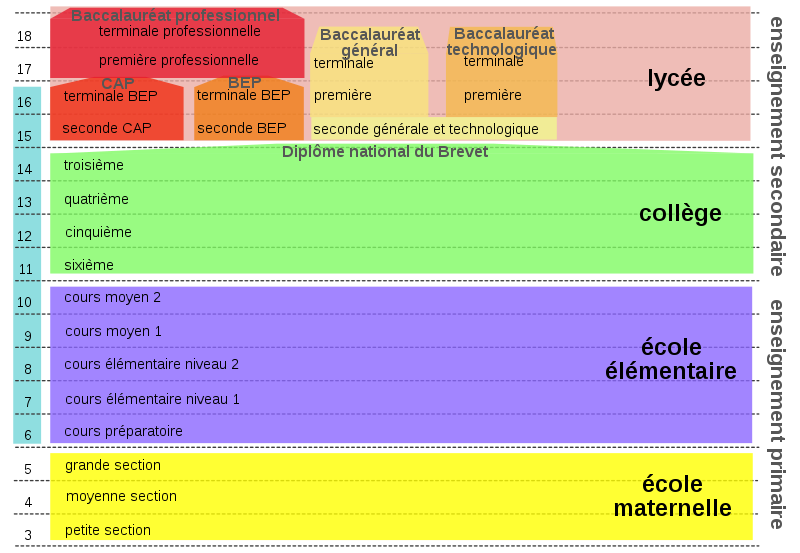
The best thing about living abroad is observing another culture that is different from your own. Working as a language assistant in a school as a foreigner has really given me the perfect opportunity to understand and watch how students learn and see how an European education system is formed. I grew up in a North American context, specifically Canadian, and with influences of Chinese and Asian culture, I’m also aware of the rigorous education system there. But I had no idea about the France education system until I got here.
Here are a few things I’ve learned over the last couple of months:
- Grades Backwards: Refer to the chart above, college (or middle school) starts the grades level backwards. Starting from the sixieme (the 6th grade) to terminale (the finish = 12th grade) this consists of your adolescent ages. College is for students between 11-15 years old and lycee (high school) is from 15-18 years old. I remember when I started working in the lycee, I always get confused between premiere (translated to 1st) and seconde (translated to 2nd). I never remember which grade was the lower one - and the lower one is the seconde because it is going backwards. So confusing!
- Early Specialization: When you finish college, you would have an examination that determines what type of lycee you would be heading towards and what you would be specializing in. Depending on your grades, you would be recommended to go to a lycee headed for university or to a more vocational school which would prepare them for the workforce. In my school, I think my students prepare for a baccalauréat général (Bac). There are 3 streams: 1) Scientific - basically science and math. 2) Economics and Social (ES) - history, geography, math, social science, economics and 3) Literature - French, foreign languages, philosophy and the arts. This is very important because depending on what you choose, this would give you prerequisites for universities admission afterwards, and also getting into any of these are dependent on your grades. They are valued differently (even though I think my literature kids are so intelligent!)
- Prioritization in Science: Science seems to be the most valued in French society. My teacher told me that some students who take Sciences specialization are not necessarily because they are interested in going to science but the fact that this section would give them the most options after their BACs for university. If you take the science option, the French education system determines that you are capable of any subject as math and science are the most difficult courses, so you can apply to the best universities and can stand a chance of being accepted. So yes, science is in the education system’s favor and not exactly fair.
I’m still learning each and everyday how the system runs as I watch and work with my students and correct me if I am wrong. This is from personal experience and from my understanding.
I am absolutely fascinated by the education system and working abroad really gave me the opportunity to learn frist hand about how other people learn and cultural differences. Suddenly, I want to travel the world to explore the differences. So exciting!
If you are interested in this article, you may be interested in my Part I: French Education.
Everyone has a story.
This is mine.

Hello! Indeed, you are living my former life ;-)
The French education system is so complicated… and I still don’t know much about the Canadian system since I completed my education in France.
If you are in France in June, you will realize how important national exams such as “le Brevet” and “le Bac” are-it’s the number one topic in the news!
I probably won’t be here in June, but I do know all about the Bac. It’s all everyone talks about - and I do work in secondary school - so I do have students in Terminals. I know its a big deal here! We don’t have a national exam like that, I don’t believe, at least in Ontario. Do you find students studious in France? I find it quite relaxing but it can depend on the students too! I really like how oral is a big component - like they have to do a big speaking component in English. So impressive!
I teach in the lycee so I am among my terminales all the time and hear all about the Bac. They have an oral component in English they have to complete, and that is my focus for them to improve on :D